The organisation

Circular Bio-based Europe Joint Undertaking

The Circular Bio-based Europe Joint Undertaking (CBE JU) is a €2 billion partnership between the European Union and the Bio-based Industries Consortium (BIC) that funds projects advancing competitive circular bio-based industries in Europe.

CBE JU is operating under the rules of Horizon Europe, the EU’s research and innovation programme, for the 2021-2031 period. The partnership is building on the success of its predecessor, the Bio-based Industries Joint Undertaking (BBI JU), while addressing the current EU policy priorities and challenges facing the industry.

What can CBE JU do for Europe?

Shifting from imports of non-renewable fossil raw materials to circular and local bio-based production processes is essential to reach the EU’s climate targets, boost the continent's competitiveness and strengthen its strategic autonomy. Strong, resource-efficient and competitive bio-based industries are important drivers of this change. By producing renewable bio-based products and materials from waste and biomass in an innovative, sustainable and circular way, they can contribute significantly to the climate neutrality target by 2050 while creating green jobs and sustainable economic growth in regions across Europe.

The role of Circular Bio-based Europe is to bring together various actors from bio-based industries, ranging from farmers to scientists, to solve the technological, regulatory and market challenges of the sector. Its public-private funding scheme boosts innovation and market deployment and paves the way for future investments.

The Strategy for a Competitive and Sustainable  EU Bioeconomy identifies CBE JU as a key instrument in scaling up circular bio-based technologies and facilitating the transition from laboratory to market. CBE JU will play a central role in the strategy implementation.
 

Acknowledged as a strategic sector for Europe, the bioeconomy is high on the EU political agenda given its ability to deliver important contribution to European competitiveness (innovation), resilience (diversification of raw material), strategic autonomy (reducing import dependencies) and security (local supply chains). 
 

The bioeconomy is included as an explicit policy window in both the EU’s Framework Programme for Research and Innovation (FP10) and European Competitiveness Fund (ECF) proposals, key policy initiatives of the EU’s ambitious multi-annual financial framework for 2028-2034. CBE JU is therefore well positioned to play a central role in bridging the gap between innovation and commercial deployment, aligning it with the EU’s priorities. The European bioeconomy sector supports this vision, as confirmed by the vast majority of respondents to the recent CBE JU Stakeholder Study
 

With an agile programming process cascading from its Strategic Research and Innovation Agenda (SRIA) , to the Multi-Annual Programming (MAP) and ultimately to the Annual Work Programme (AWP), the CBE JU has a resilient alignment mechanism to new and emerging political priorities, and a robust  crisis response framework.  For example, the 2026 AWP strongly aligns with the Biotechnology and Biomanufacturing Communication, the Competitiveness Compass, the Clean Industrial Deal, the European Chemicals Industry Action Plan, the Strategy for a Competitive and Sustainable  EU Bioeconomy and the EU Fertiliser Action Plan
 

Several European Commission policy departments are represented on the CBE JU Governing Board (DG RTD, DG AGRI, DG GROW, and DG ENV) fostering a coordinated and cross-sectoral policy approach. In addition, the CBE JU governance structure, which includes advisory bodies representing the Member States and the scientific community, as well as dedicated deployment groups, is highly inclusive. This supports an essential feature of the Joint Undertaking model whose remit spans multiple industrial sectors and covers the scale-up of innovative bio-based solutions from lab to first-of-a-kind industrial plants. 

Learn more about CBE JU's contribution to EU policies

Bringing innovation to the market is a central pilar of European competitiveness. The CBE JU has played a pivotal role in de-risking investments, leading to the scale-up of innovative bio-based solutions.
 

CBE JU has allocated 80% of its total budget to Innovation Actions, covering scale-up from prototype to product validation and market replication. This is the highest deployment-intensity ratio in the Horizon Europe Joint Undertaking portfolio, with TRLs 6 to 8 covering  first-of-their-kind flagship industrial demonstrators
 

23 flagship biorefineries and 198 demonstrators have been built or are under construction with CBE JU support, mobilising €2.5 billion of total investment. In the BBI JU (predecessor of CBE JU) programme, every €1 of EU funding invested in flagship and demo projects has attracted approximately €5 of private investment. This leverage effect demonstrates the Joint Undertaking’s ability to trigger, attract and mobilise private investments in Europe, particularly through its funding of projects at higher TRL levels, at a time when the EU faces growing competition from other regions of the world for that same investment.
 

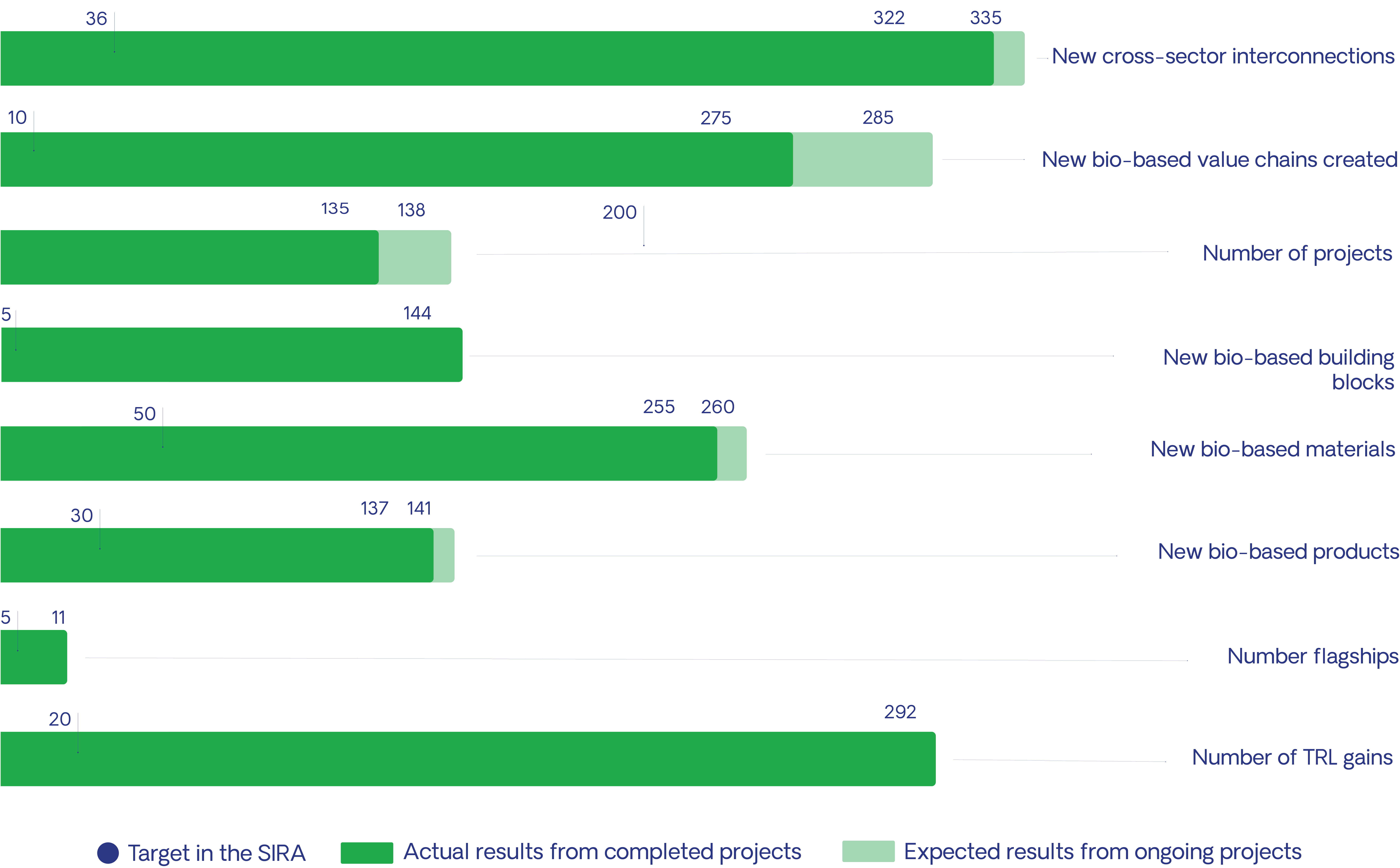
CBE JU Key Performance Indicators (KPIs) show the impact of EU funding on research and innovation and track the programme’s progress. 

All BBI JU KPIs linked to project outputs exceeded their initial targets
 

BBI JU KPIs


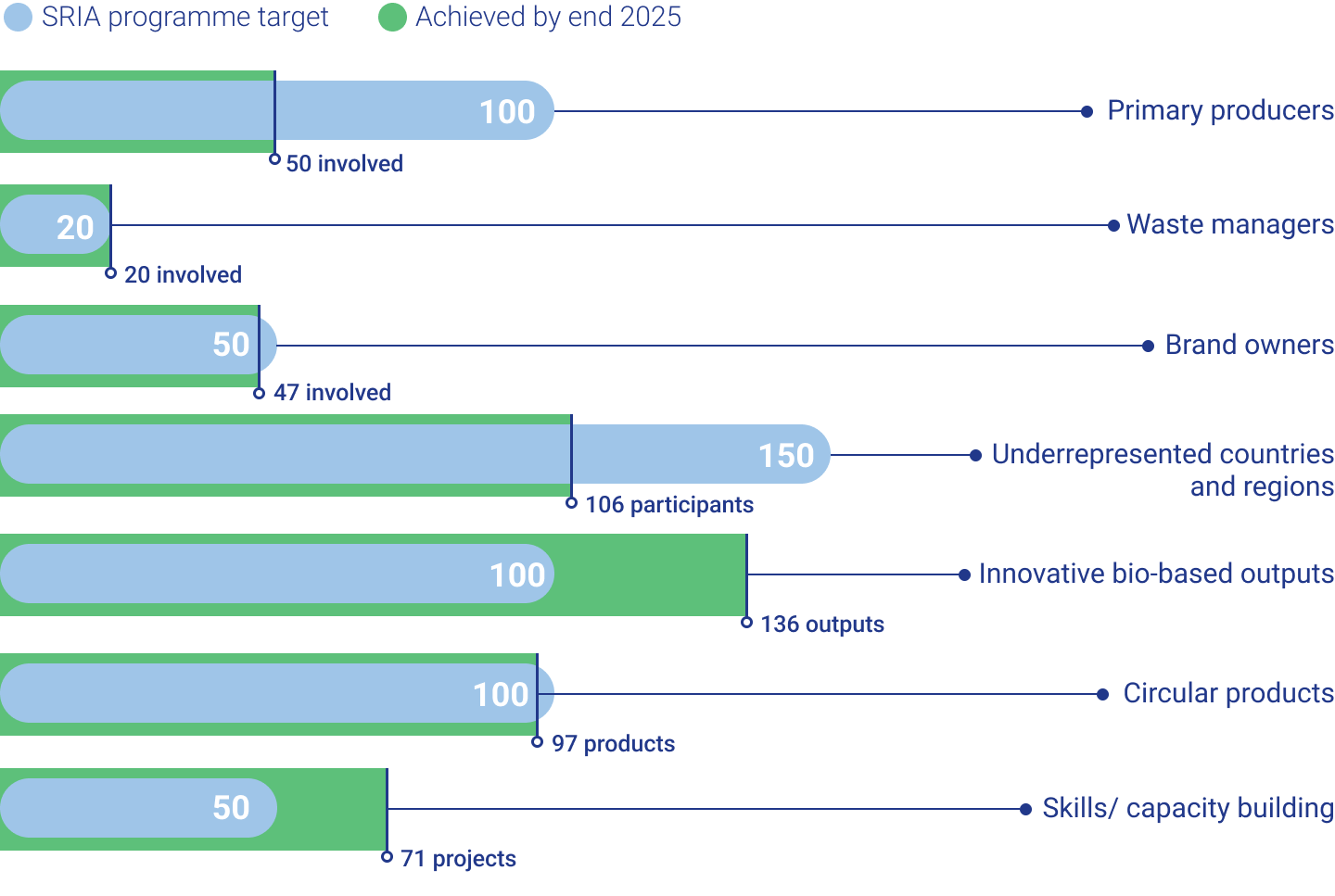
While the majority of CBE JU-funded projects are still in the early stages, the KPIs are well on track to be met, or exceeded, in all areas. This provides strong evidence that the CBE JU programme is generating higher industrial and environmental impact than the SRIA targets, indicating a high level of effectiveness of the Joint Undertaking instrument.
 

2025 highlights 2


Going beyond project management, the CBE JU has played a key role in informing policymakers of the challenges faced by funded projects in commercialising innovative ideas in Europe. One such challenge is access to finance. Bio-based innovation is capital-intensive in nature, has a high technological risk and takes a long time to see a return on investment (>10 years). To tackle this challenge, the Bioeconomy Investment Deployment Group works on mobilising private investments along the full scale-up journey, bridging research and innovation with “first-of-a-kind” plants at commercial scale. This action is complementary to the European Competitiveness Fund (ECF) proposal.
Amid an increasingly challenging geopolitical context and mounting competition from other regions in strategic sectors, attracting and retaining private investment for European innovation remains a key challenge. The CBE JU has proven effective in attracting and retaining such investment, demonstrating that it is an efficient instrument for keeping strategic capital in Europe.
 

For every €1 of EU funding, BBI JU, the predecessor of CBE JU, mobilised private investments of €3.65, well above the leverage effect target of €2.85. At the higher TRLs, the leverage effect increases: every €1 of EU funding invested in flagship and demo projects has attracted approximately €5.2 of private investment. With many projects still at early stages, the CBE JU leverage effect stands at €1.28, higher than the target objective of €1 and well on track to reach the expected programme results.
 

Beyond leveraging public funding, the Joint Undertaking plays a key role in attracting industry investment, through in-kind contributions and additional investments, into a strategic and fast-growing sector that is essential to delivering EU’s policy priorities. The inclusion of mandatory targets for in-kind contributions to operational activities (IKOP) in higher TRL topics has been highly effective, with the current projection for the two forthcoming calls already surpassing the target. 

CBE JU is implementing a comprehensive Synergies Strategy to coordinate with other European, national and regional initiatives across four priorities: strategic planning; coordinated programming; portfolio-level synergies; and awareness raising. It also identifies the potentiality of funding synergies with national and regional mechanisms (ERDF, CAP, RRF, JTF). 
 

In this framework, CBE JU recently signed a Memorandum of Understanding (MoU) with four organisations representing the regional dimension of the bioeconomy. With the overarching objective of supporting the bio-based industries to scale up and replicate results of CBE JU-funded projects, the MoU signatories commit to support SMEs in accessing funding opportunities at national and regional levels. 
 

The CBE JU KPI impact dashboard tracks scientific, economic and environmental indicators across all 82 funded projects. 

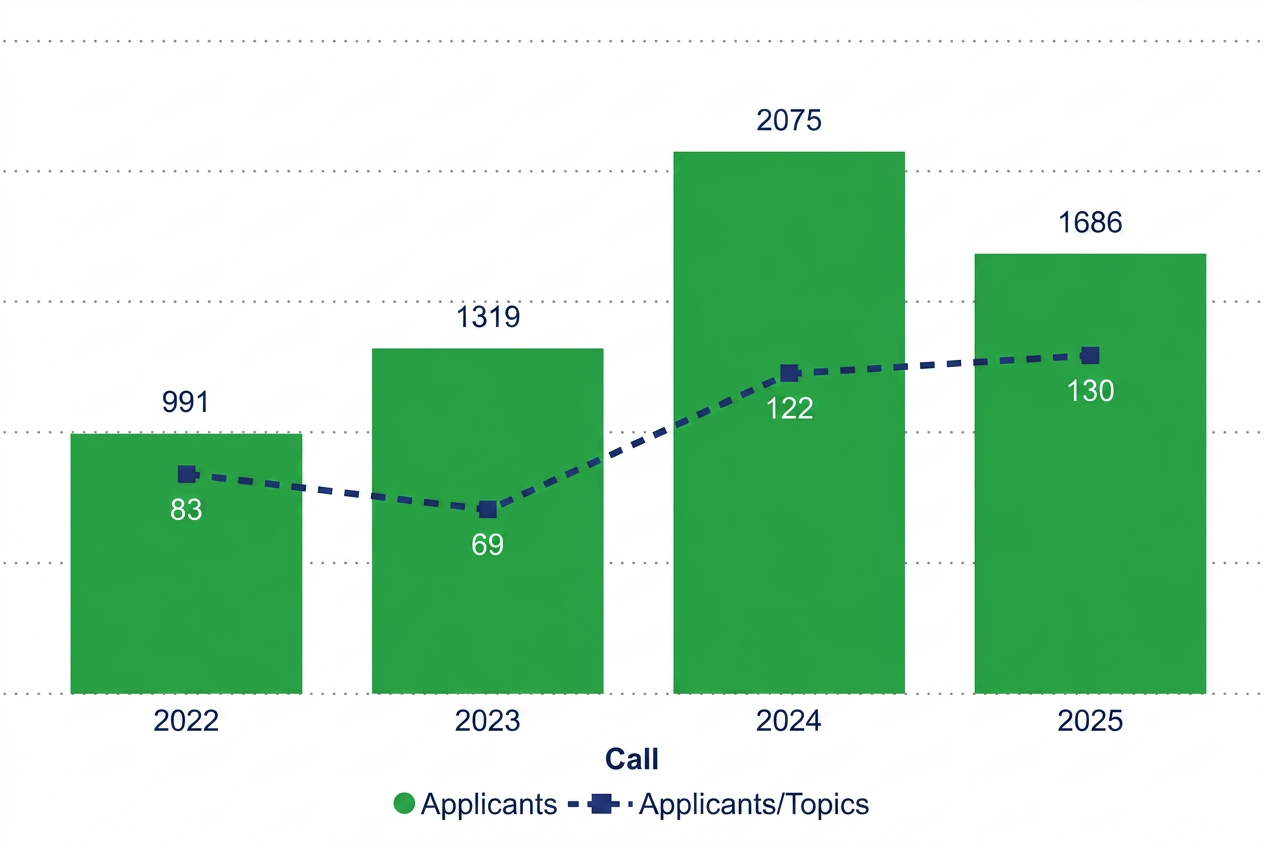
Since its establishment, the CBE JU programme has steadily grown in attractiveness, with the number of applicants per topic increasing year on year. To date, BBI JU/CBE JU has attracted 4,171 unique applicants to the programme. 55% of all participants to the programme are newcomers - participants who have never received funding from CBE JU nor BBI JU. The CBE JU open participation model for applicants allows any legal entity to apply to calls without paying the private membership fees — the primary structural reason for CBE JU's exceptional openness metrics.
 

Applicants to CBE JU calls

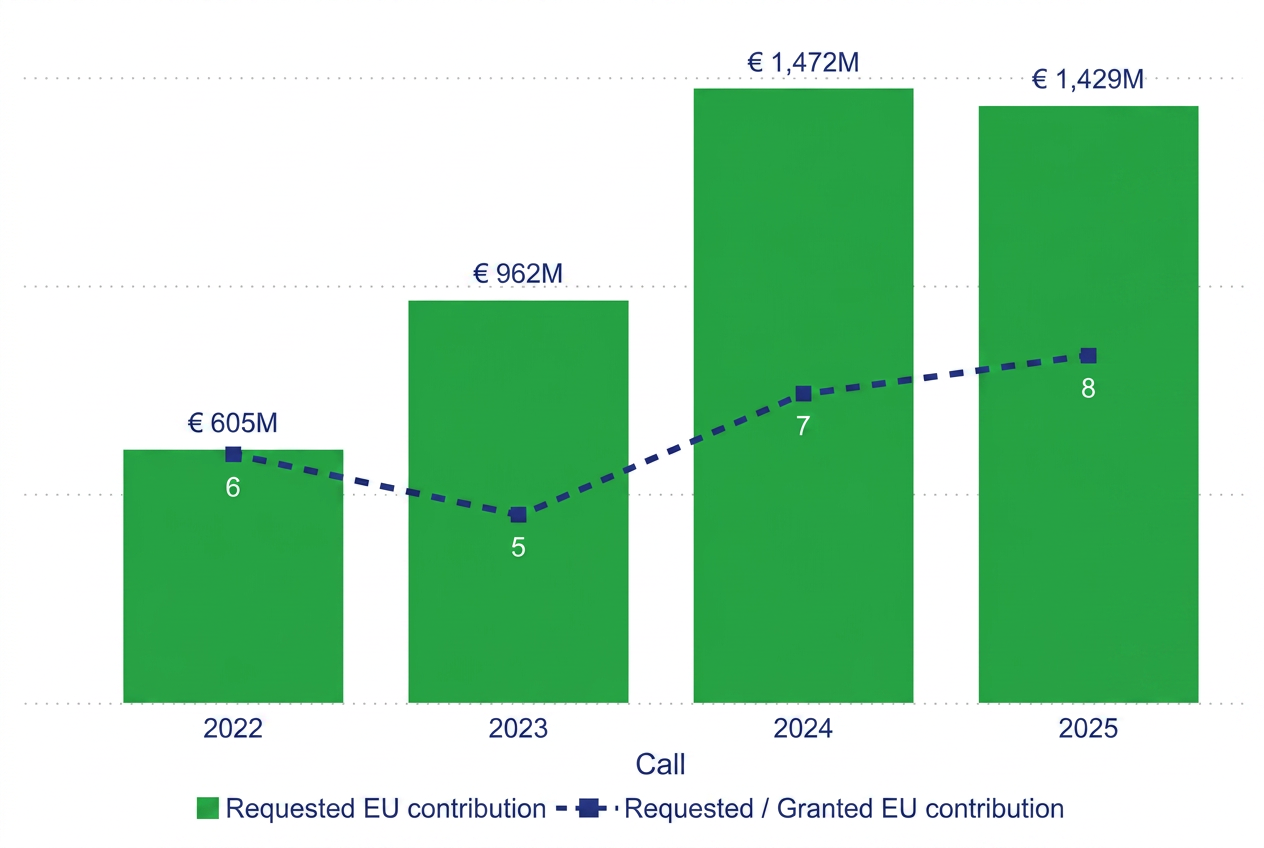
In terms of requested EU contribution by applicant, it is clear that the Joint Undertaking instrument is delivering an impact in the expanding bio-based sector.  The 2025 call for project proposals demonstrates that the programme remains attractive for the sector with a record 240 eligible proposals requesting over €1.4 billion in funding. 45% of call applicants were newcomers, predominantly from industry and SMEs. The figures demonstrate that CBE JU has not yet reached saturation point - engagement is still expanding, particularly in the private sector.
 

Requested contribution in CBE JU calls


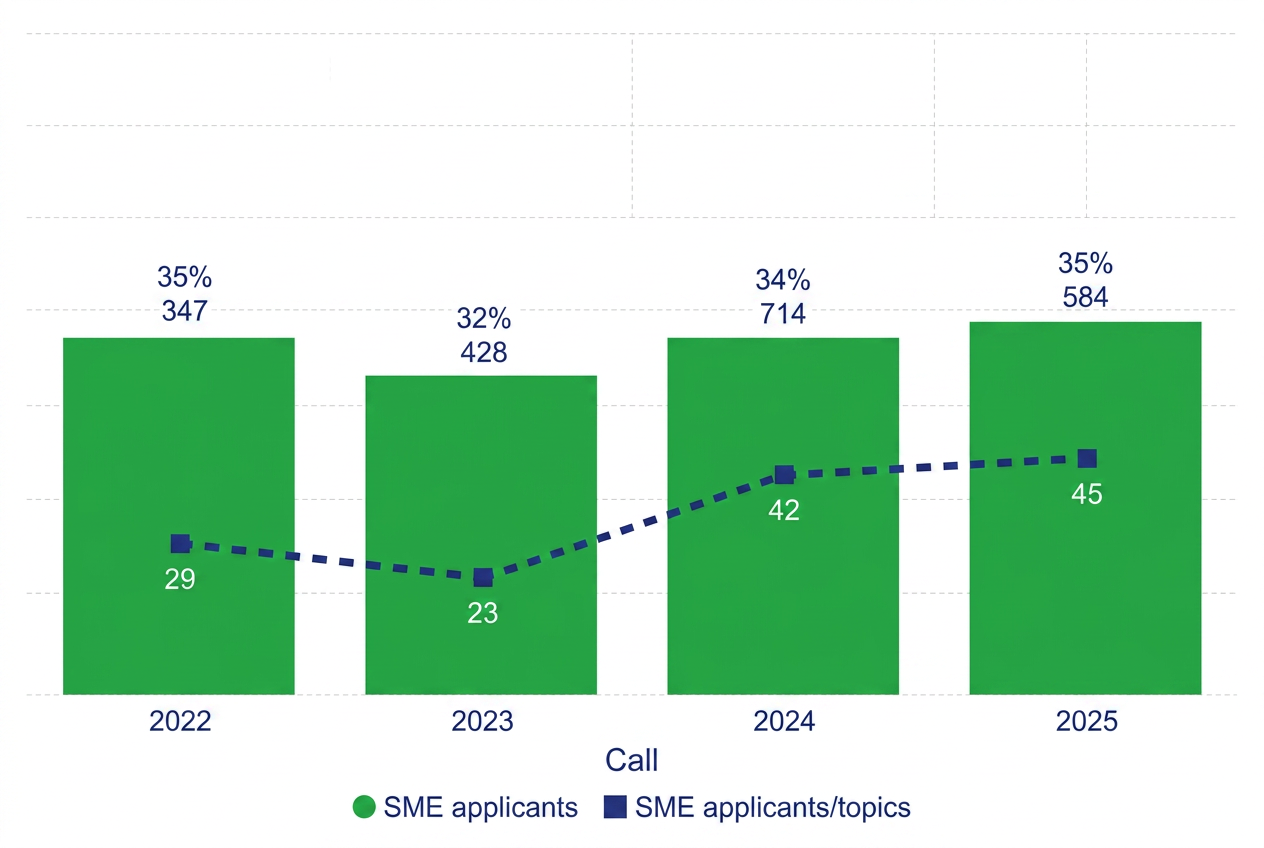
SMEs account for 38% of participation and receive 35% of EU funding, consistently above the Horizon Europe average. 40% of flagship projects are led by SMEs, showing openness extends to programme leadership, not just participation.

SME applicants to CBE JU calls


CBE JU’s Widening Participation Strategy is delivering results. The 2025 call for project proposals witnessed participation from widening countries growing more strongly than from other Member States. The KPI target of 150 newcomer participants from underrepresented countries is clearly on track.

Public-private collaboration for a sustainable and competitive Europe

CBE JU is established under Council regulation (EU) 2021/2085 of 19 November 2021 as an institutionalised European partnership between the European Union, represented by the European Commission, and the Bio-based Industries Consortium (BIC). CBE JU is the legal and universal successor of BBI JU in respect of all contracts, grant agreements and liabilities.

The CBE JU’s decision-making body is its Governing Board. The role of the CBE JU Programme Office, led by its Executive Director, is to ensure the implementation of the partnership. CBE JU also has two advisory bodies, the States’ Representatives Group and the Scientific Committee, as well as working and deployment groups.

Learn more about CBE JU’s governance