CBE JU translates EU policy priorities into market-ready bio-based solutions. By pooling public and private investment, the partnership brings innovation to the market, strengthens European competitiveness and builds sustainable value chains across Europe.

1.45
billion euros in investment

243
supported projects

23
first-of-their-kind flagship biorefineries

198
demonstration plants
Contributing to the European Commission’s priorities (2024–2029)
CBE JU contributes to the delivery of the European Commission’s political priorities (2024–2029) through targeted investments and industrial-scale projects.
.
De-risking investment
38% of CBE JU participants are SMEs benefitting from public-private funding, access to pilot and demonstration facilities, and reduced risk when attracting additional financing.
Building a Clean Industrial Deal to decarbonise the continent
Scaling up bio-based industries that reduce GHG emissions and replace fossil-based inputs.
Putting research and innovation at the heart of Europe’s economy
243 highly innovative projects across 46 countries have benefitted from €1.45 billion in EU funding, supporting Europe’s leadership in bio-based innovation.
Fostering a more circular and resilient economy
Projects transform waste, residues and sidestreams through fully circular production models, reducing reliance on fossil imports and strengthening Europe’s resilience.
Accelerating the digital transformation of industry
Many CBE JU-funded projects deploy digital process monitoring, data-driven optimisation and automation to improve efficiency, traceability and performance in biorefineries.
Investing in sustainable competitiveness
Each €1 of EU funding has mobilised €3.65 of private investment in BBI JU programme, the predecessor of CBE JU. Every €1 of EU funding invested in flagship and demo projects has attracted approximately €5.2 of private investment. With many projects still at early stages, the CBE JU leverage effect stands at €1.28, higher than the target objective of €1.
Tackling the skills and labour gap
Projects contribute to building regional skills, industrial capacity and long-term employment opportunities.
CBE JU alignment with EU strategies and policies
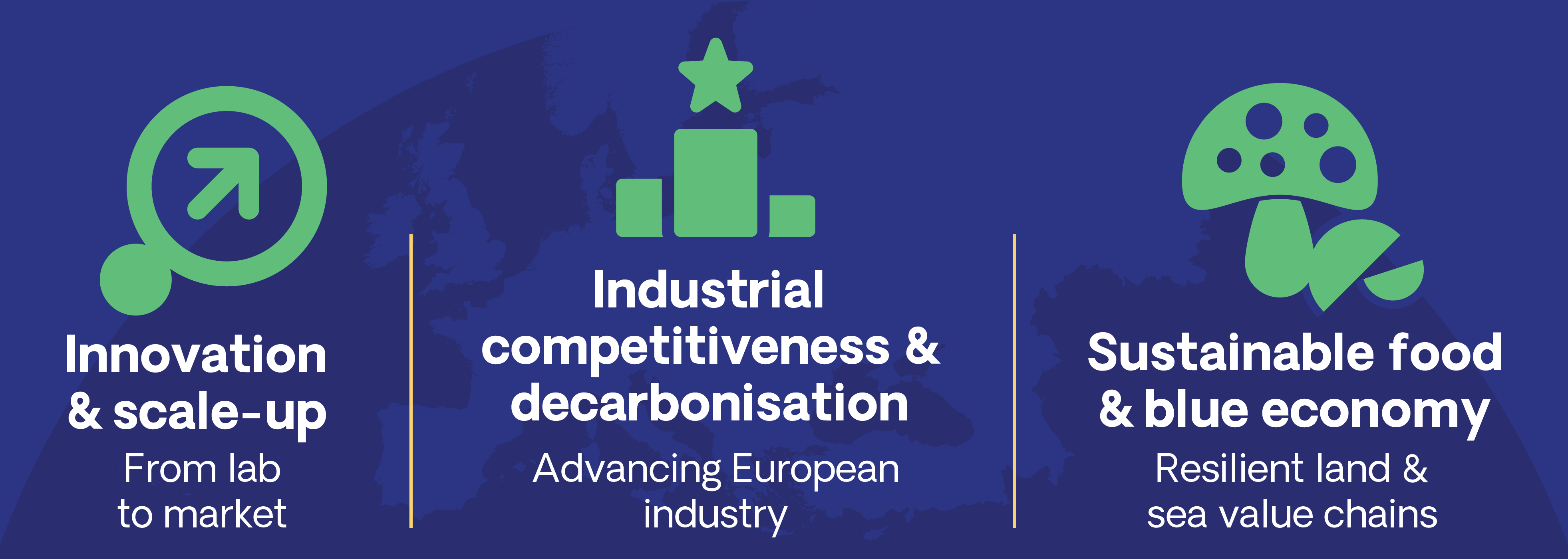
How does CBE JU bring bio-based innovation from lab to market?
EU strategies are increasingly focused on accelerating innovation, scaling up industrial capacity and strengthening Europe’s leadership in bio-based solutions. CBE JU plays a central role in translating these ambitions into industrial reality.
- EU policy context: The updated EU Bioeconomy Strategy aims to strengthen the EU’s leadership by establishing a competitive and sustainable EU bioeconomy, fostering innovation, reinforcing sustainability and circularity, and supporting the market uptake of bio-based solutions.
- CBE JU contribution: Advances bio-based innovations from research to market by de-risking investments and supporting the creation of strong, integrated industrial value chains across Europe.
- Project example: Circular Biocarbon converts urban organic waste into high-value bio-based products such as biopolymers and advanced materials for applications ranging from bio-fertilisers to photonic devices.
- Learn more: CBE JU welcomes the EU’s Bioeconomy Strategy
- EU policy context: The European Life Sciences Strategy places strong emphasis on the bioeconomy and bio-based innovation, aiming to reinforce the EU’s global leadership in life sciences, biotechnology, biomanufacturing and bio-based sectors.
- CBE JU contribution: Strengthens Europe’s biomanufacturing capacity by supporting first-of-their-kind demonstration plants and flagship biorefineries.
- Project example: The DEEP PURPLE project transforms wastewater and sewage sludge into feedstock for bio-based plastics, cosmetics, fertilisers and construction materials. Using a versatile multi-platform biorefinery and purple phototrophic bacteria, it turns waste management challenges into circular economy opportunities, showcasing scalable, sustainable bio-based innovation.
- Learn more: Driving the bioeconomy: CBE JU's role in Europe’s new life sciences strategy
- EU policy context: The EU Startup and Scaleup Strategy aims to make Europe the best place to start and scale global technology-driven companies. This is particularly relevant for the bio-based sector, where SMEs play a major role.
- CBE JU contribution: Supports SME-driven innovation by providing access to pilot and demonstration facilities, enabling faster scale-up and market entry.
- Project example: SWEETWOODS built a pioneering flagship biorefinery in Estonia that converts at least 90% of wood feedstock into high-value bio-based chemicals, catalysing a new forestry-based industrial hub.
- Learn more: New strategy to support European startups and scaleups
How does CBE JU boost competitive, low-carbon industry?
To remain competitive while achieving climate neutrality, Europe must modernise its industrial base and reduce dependence on fossil resources. CBE JU contributes to these objectives by funding bio-based industrial solutions that combine defossilation, resource efficiency and competitiveness.
- EU policy context: The EU Competitiveness Compass provides a forward-looking framework to guide investment into Europe’s strategic industrial ecosystems and innovation capacity.
- CBE JU contribution: Strengthens competitiveness by funding projects that create new European value chains for bio-based products and materials, as well as boost local economies.
- Project example: AFTERBIOCHEM works with local farmers to produce bio-based molecules from sugar beet residues for cosmetics and polymers.
- Learn more: Accelerating EU competitiveness with bio-based innovation
- EU policy context: The EU’s Clean Industrial Deal is a roadmap for a variety of policies aimed at accelerating Europe’s reindustrialisation and decarbonisation. This initiative supports strengthening industrial competitiveness, while achieving the EU’s goal of climate neutrality by 2050, a goal shared by CBE JU with the partnership’s continuous support to scaling up Europe’s bio-based sector.
- CBE JU contribution: Scales up bio-based industries that cut emissions and reduce reliance on fossil inputs.
- Project example: PEFerence scales up 100% bio-based PEF as a recyclable alternative to fossil-based PET. Backed by €25 million of CBE JU funding and €20 million in private investment, its Delfzijl plant opened in October 2024 and has since been delivering bio-based products to large companies.
- Learn more: Sustainable reindustrialisation: CBE JU’s bio-based impact on Europe’s industry
- EU policy context: The European Chemicals Industry Action Plan recognises bio-based chemicals as a strategic pathway for achieving climate neutrality, industrial decarbonisation and circularity in a key European sector.
- CBE JU contribution: Supports innovative and renewable chemical production and sustainable-by-design materials.
- Project example: VIOBOND produces around 45,000 tonnes of lignin-based resins per year, replacing fossil-based adhesives in construction.
- Learn more: CBE JU welcomes the European Chemicals Industry Action Plan: Bio-based solutions powering a sustainable industrial transformation
How does CBE JU support sustainable food systems & blue economy?
The transition to sustainable food systems and a resilient blue economy is central to Europe’s long-term food security, environmental protection and economic resilience. CBE JU supports this transition by enabling industrial-scale bio-based solutions that transform agricultural and marine biomass, diversify protein sources and create new, sustainable value chains.
- EU policy context: The European Commission’s Vision for the future of agriculture and food in Europe aims to create a competitive, resilient and sustainable agricultural food sector by 2040.
- CBE JU contribution: Supports the creation of new revenue streams and business opportunities for European farmers, while encouraging sustainable farming practices with bio-based solutions.
- Project example: UNLOCK converts poultry feather waste into keratin-based biodegradable materials for agriculture, illustrating how bio-based innovation can strengthen farm resilience, reduce environmental impact and drive circular value chains.
- Learn more: Cultivating a better tomorrow: how bio-based innovations are strengthening EU’s food production
- EU policy context: The European Ocean Pact is a framework designed to safeguard ocean health while fully leveraging Europe’s maritime assets, promoting the blue bioeconomy, with a focus on sustainable algae cultivation and the transformation of by-products from aquaculture.
- CBE JU contribution: Pioneers industrial-scale circular solutions for the aquaculture and algae sectors.
- Project example: SCALE has built and operates Europe’s first industrial flagship plant to produce high-value nutritional ingredients from diverse microalgae using sustainable photobioreactor technology.
- Learn more: Investing in the blue bioeconomy: European Ocean Pact launched
- EU policy context: The EU’s Protein Strategy aims to strengthen sustainable food systems and improve food security by reducing Europe’s reliance on imports, while advancing climate, biodiversity and nutrition goals through the uptake of alternative proteins and healthier, more resilient diets.
- CBE JU contribution: Scales up the production of sustainable proteins from diverse biomass sources and sidestreams, reducing dependency on imports while supporting healthier, low-impact food and feed systems.
- Project example: PLENITUDE has opened a pioneering biorefinery in the Netherlands, producing ABUNDA, a fibre-rich mycoprotein for food, pet food and packaging applications.
- Learn more: From plants to bugs: Europe’s alternative protein revolution