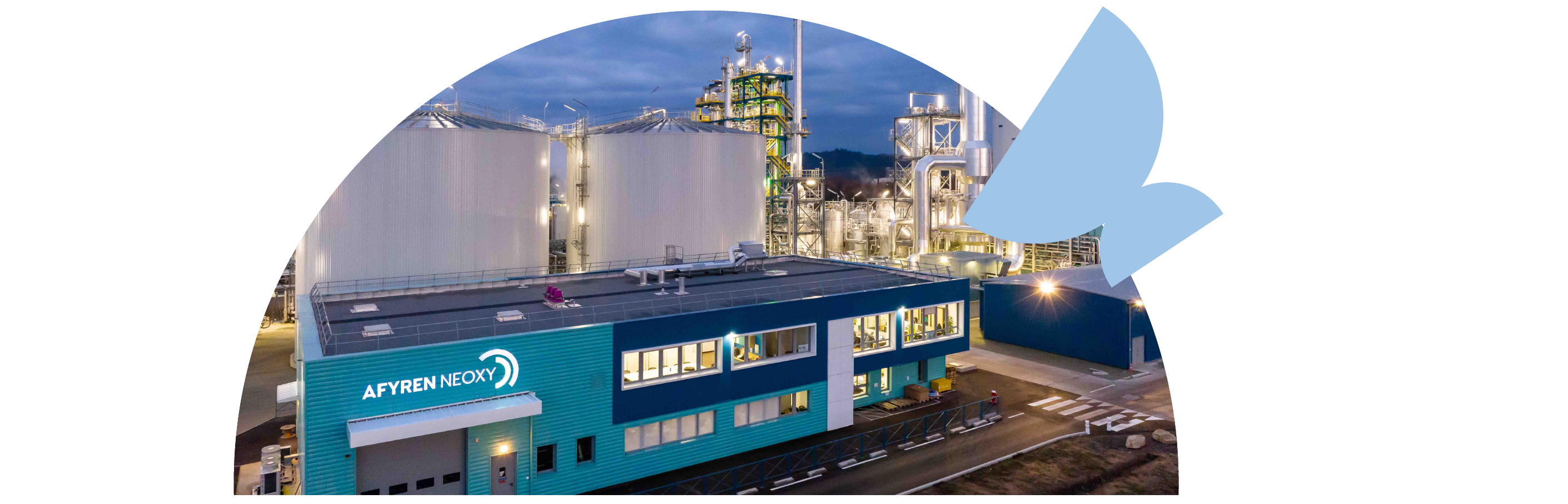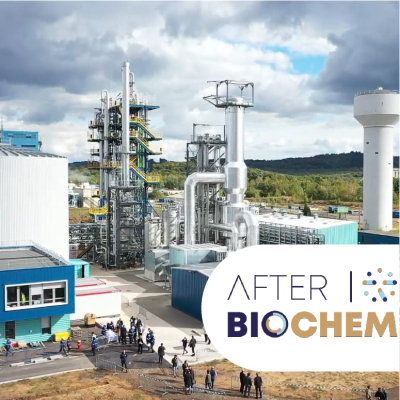
The AFTERBIOCHEM project, led by AFYREN, a French SME, has built a first-of-its-kind biorefinery in Saint-Avold, eastern France. This plant converts sugar beet residues into seven novel bio-based acids that replace fossil-based ingredients for sectors including food, feed, cosmetics, pharmaceuticals, personal care, lubricants and other industries, alongside a potassium-rich fertiliser by-product. With €20 million in CBE JU co-funding across a 12-partner consortium, the plant opened in September 2022. It has created 85 direct jobs, with a further 250 supported indirectly in the surrounding Grand Est region, and diversified the income streams of local sugar beet producers.
Since the project closed, that early industrial base has become the foundation for a much larger commercial story.

Ramping up to full industrial scale
After reaching continuous industrial operation in April 2025, AFYREN NEOXY has moved steadily from start-up to sustained production. In 2025 the plant produced around 400 tonnes of bio-based acids, alongside a significant volume of fertiliser. All of this output was already sold. Momentum has since accelerated. In the first half of 2026, the plant generated roughly €1 million in revenue, twice its full-year 2025 total, with demonstrated production capacity reaching 20% of its original 16,000-tonne annual target. AFYREN reports a pre-sold order book worth around €165 million for its acids and fertilisers and has now launched an optimisation programme to further develop production capacity.
In March 2026, AFYREN took full ownership of the AFYREN NEOXY biorefinery, simplifying its financial reporting and clearing the way for further performance investment at the site.
Certified for impact, backed for growth
AFYREN's progress has been matched by external recognition and funding. In June 2026, the company achieved group-level B Corp™ certification (an independent standard for social and environmental performance) with a score of 104, above both national and sector benchmarks. It also holds product and management system certifications including ECOCERT, COSMOS, Responsible Care® and ISO 9001. The same month, AFYREN published its third voluntary sustainability report, aligned with the EU's corporate sustainability reporting directive.

To support the next phase of investment, AFYREN has also drawn on continued public backing: a €3 million grant from the Grand Est Region under the EU's Just Transition Fund, and the final €2.2 million instalment of a grant from Bpifrance's "France Relance" programme, both announced in April 2026.
Growing the team, eyeing new markets
AFYREN's headcount has grown alongside production, from around 130 employees at the end of 2024 to 140 across its Lyon, Clermont-Ferrand and Carling Saint-Avold sites by the end of 2025. Beyond Europe, the company is building its presence overseas through distribution agreements, extending the reach of technology first proven at pilot scale through AFTERBIOCHEM.
AFTERBIOCHEM is a true catalyst in the construction of our industrial plant. By duplicating the flagship biorefinery in Europe and the world, we will develop additional circular and low-carbon bioeconomy models. We are very thankful to CBE-JU and the European Union for their longstanding support.
Nicolas Sordet, CEO of AFYREN NEOXY
Bio-industrial projects of this kind are notoriously hard to finance. They are capital-intensive, risky and slow to deliver returns.
Closing the loop of our project financing would have been more complicated without the CBE JU support. It is crucial help for bio-industrial projects by nature difficult to finance. Programmes such as CBE-JU are a real accelerator for bioeconomy start-ups and industrialisation, working as a catalyst in addition to private investor funds.
Nicolas Sordet, CEO of AFYREN NEOXY