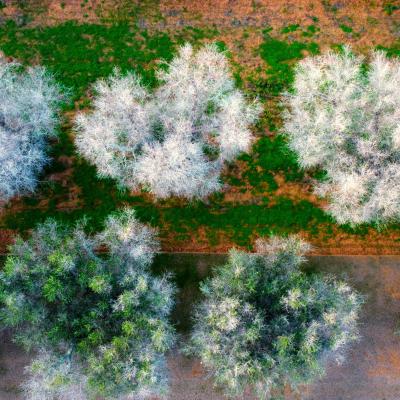
The CBE JU-funded BIOVEXO project was launched in response to the rapid spread of Xylella fastidiosa, one of the most destructive plant pathogens affecting Europe’s olive and almond sectors. This bacterium, transmitted by insect vectors such as spittlebugs, has caused widespread tree mortality across the Mediterranean, with some regions experiencing a 65 to 80 % decline in olive production.
Until this project, no effective and sustainable solutions were available to control the disease,” explains BIOVEXO project manager Francine Martin from RTDS Group, the project coordinator based in Austria. “Existing measures relied mainly on insecticides, which are often insufficient and environmentally harmful.”
Bio-based, sustainable plant protection strategies
To address this situation, BIOVEXO sought to develop innovative biopesticides that target both the bacterium and its insect vector. The project focused on identifying and validating a portfolio of biological solutions, including beneficial bacterial strains, natural plant extracts, microbial metabolites and entomopathogenic fungi. This was a collaborative initiative carried out by a multidisciplinary consortium of research organisations, industry partners, SMEs and farmer associations.
“BIOVEXO followed a comprehensive innovation pipeline, moving from discovery to real-world validation,” says Martin. “This involved: the screening and optimisation of biocontrol agents; the development, formulation and upscaling of X-biopesticides (targeting the bacterium) and V-biopesticides (targeting the vector); as well as environmental, toxicological and regulatory assessments.”
Promising biopesticides were then tested in field trials under real agricultural conditions. These were conducted in Xylella-affected regions such as Apulia in Italy and Mallorca in Spain, with repeated applications adapted to seasonal conditions.
Curative trials were conducted in infected olive and almond orchards, while preventive trials based on integrated pest management (IPM) were conducted in newly planted orchards. IPM is an ecosystem-based strategy that combines techniques such as biological control, habitat manipulation and the use of resistant varieties.
“These trials combined multiple treatments and involved continuous monitoring of symptoms, bacterial populations and plant physiological responses,” adds Martin. “Life-cycle assessment and regulatory compliance activities were also carried out to ensure that solutions were both effective and sustainable.”
Enhanced resilience and reduced stress
A key success has been the commercialisation of a V-biopesticide (Sankari, developed by project partner Globachem). This demonstrated good efficacy in reducing both juvenile and adult populations of spittlebugs, confirming its value as part of vector control strategies.
“Sankari – a product based on nonanoic acid – demonstrated strong efficacy within IPM strategies,” says Martin. “Regulatory approvals have already been secured in some countries, with further registrations expected in key markets.”
Preventive IPM trials also showed that combining bacterium-targeting and vector-targeting treatments can significantly reduce infection rates. Physiological analyses indicated that treated plants – especially young olive trees – exhibited improved transpiration and lower canopy temperatures, suggesting enhanced resilience and reduced stress.
Implementing integrated pest management
To support uptake at farm level moving forward, BIOVEXO has developed a practical booklet that provides recommendations for farmers on implementing IPM. “This translates project results into clear, actionable guidance for end users,” adds Martin.
“A key lesson learned is that no single product provides a complete solution. Instead, the most effective approach lies in integrated strategies that simultaneously target the bacterium and its vector, tailored to specific agronomic and environmental contexts.”
Future work will therefore focus on optimising these integrated approaches and supporting their uptake at scale. “Overall, the project has moved beyond concept validation to tangible market deployment and near-market innovations,” remarks Martin. “This has laid the groundwork for sustainable, bio-based crop protection solutions that can be adopted across Europe’s olive and almond sectors.”
