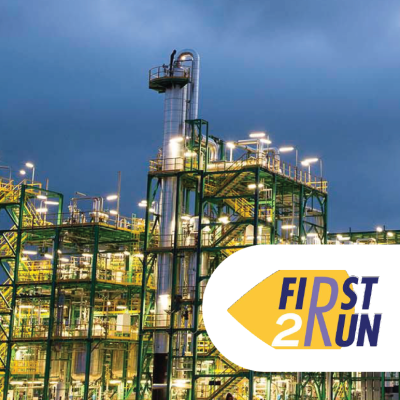
The FIRST2RUN flagship project at the Porto Torres (Sardinia, Italy) biorefinery set out to prove that dry, low-input crops grown on arid, marginal land could feed a fully integrated biorefinery. It turned vegetable seed oil into bio-based chemicals and products. Led by Italian company Novamont, the project demonstrated that this first-of-a-kind value chain could work at industrial scale, technically, economically and environmentally.
Since the project's completion in June 2019, the biorefinery has kept building on that foundation. The plant now has a commercial capacity of around 30,000 tonnes a year. It uses the vegetable oil extraction and conversion technology demonstrated under FIRST2RUN to produce biolubricants, bioadditives, azelaic acid and pelargonic acid from agricultural feedstock.
Innovative bio-based products available on the market

The biorefinery now supplies a growing range of bio-based chemicals under its Matrilox® brand, including high-purity acids for premium market segments, a blend of carboxylic acids, glycerine and a range of esters. Building further on the cardoon value chain demonstrated under FIRST2RUN, Novamont has since developed other proprietary technology extending the crop use beyond the seed oil alone.
A model for industrial reconversion
Beyond its product pipeline, FIRST2RUN has become a reference case for how a flagship biorefinery investment can anchor industrial reconversion in a region built around heavy industry. The biorefinery was created by converting a former petrochemical site in Porto Torres into an integrated green chemistry complex, as part of a combined investment of around €500 million. FIRST2RUN itself was backed by a further €17 million CBE JU grant awarded in 2015 and used the site to demonstrate at industrial scale that low-input dry crops, grown on arid and marginal Sardinian land, could anchor a sustainable, first-of-its-kind bio-based value chain.