The SSUCHY research and innovation project set out to prove that plant fibres and bio-based polymers could match the structural and functional performance of conventional composites in demanding sectors such as aerospace, automotive and acoustics. Co-funded by CBE JU and coordinated by the Université Marie et Louis Pasteur, formerly University of Franche-Comté (France), the project brought together 20 partners to develop hemp fibre reinforcements and bio-based epoxy resins capable of competing with fossil-based alternatives. The project included a bio-composite aircraft dashboard demonstrator.
A lighter, greener scooter frame

One of the project's four product demonstrators, developed with Dutch manufacturer NPSP, replaced a steel scooter frame with a bio-based composite one. The redesign cut the part's weight by 59%, down to just 13 kg, while raising its bio-based content to 65%. Measured across its full life cycle, the new frame also reduced emissions by up to 11% compared with the steel-frame benchmark it replaced.
Since the project's completion in February 2022, several consortium partners have carried project results into commercial and industrial use, turning a research result into products for the market.
Through CBE JU funding, SSUCHY was able to build a multidisciplinary and cross-sectoral community that brought together academic and industrial partners to address the challenges of developing sustainable bio-based composite materials. Throughout the project, we learned to work across disciplines, establish a common language despite our diverse backgrounds, and converge towards shared objectives to develop and promote this new generation of bio-based materials.
Vincent Placet, SSUCHY Project Coordinator and Research Engineer at FEMTO-ST Institute, Université Marie et Louis Pasteur
From fibre supply chain to wind turbine blades
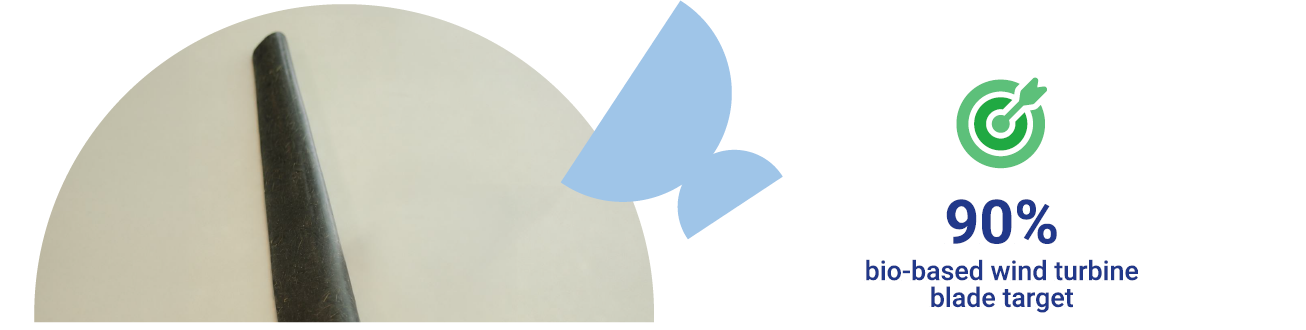
Consortium partner Linificio e Canapificio Nazionale (Italy) is now scaling up hemp reinforcements for high-volume markets through SSUCHY-Next, a follow-on demonstration project. Backed by further CBE JU funding and a 15-partner-wide consortium, SSUCHY-Next is advancing the hemp fibre supply chain and bio-based resins towards higher technology readiness. The project’s target is to build a 12.6-metre wind turbine blade that is at least 90% bio-based - one of the most demanding structural applications a natural-fibre composite can be put to.
Taking bio-composites into the listening room
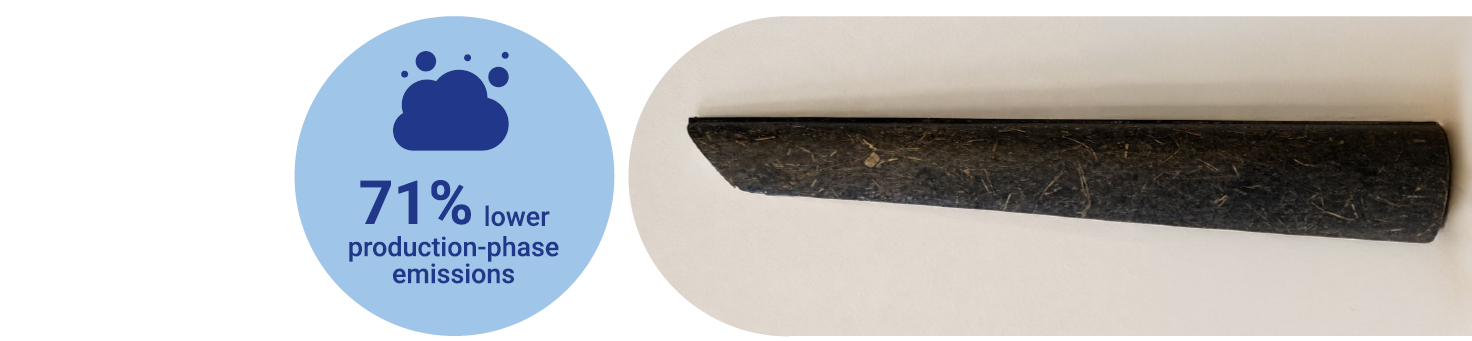
UK-based high-end audio manufacturer Wilson Benesch has taken a different route to market, integrating SSUCHY's bio-based composite developments into its product line. Its 3Zero biocomposite Monocoque, used in premium loudspeaker enclosures, is a direct commercial outcome of the materials developed within the project. It shows that structural biocomposites can also succeed in high-precision, performance-driven consumer products. With this new material, the production-phase emissions decrease by up to 71%, and the redesigned structure allows for new approaches to sound tuning.