Adobe Stock - Pixel-Shot
Publication date:
The CBE JU Working Group on Primary Producers has developed an action plan setting out eight practical measures to help primary producers participate in bio-based innovation and benefit from the value chains developed around them. The plan focuses on new business opportunities and stronger cooperation with partners across bio-based value chains.
Primary producers supply essential biological resources for Europe's bio-based industries. They can also play a greater role in developing innovative products and generate additional income by making better use of biomass and by-products.
However, limited access to business advice and potential partners can make it difficult for primary producers, particularly smaller entities, to participate in new bio-based value chains. The action plan addresses these barriers with practical measures developed around their needs.
There are significant opportunities for all primary producers to benefit from new bio-based value chains and to move beyond the position of passive price-takers. This can only happen through greater collaboration both between primary producers and across sectors. Producer co-operatives can aggregate for scale, more efficient logistics and processing and market access, but the real power comes in going a further step, collaborating with research organisations and industry and even to co-ownership of facilities. That brings next generation research to commercial reality, brings full value chain integration and a fairer distribution of value.
John Brosnan, Chair of CBE JU Working Group on Primary Producers
An action plan shaped by primary producers
Established in June 2025, the CBE JU Working Group on Primary Producers brings together representatives of agriculture, forestry and the aquatic primary sector, including fisheries and aquaculture.
With support from the CBE JU-funded RootLinks project, working group members developed the action plan based on the challenges and opportunities identified within their sectors.
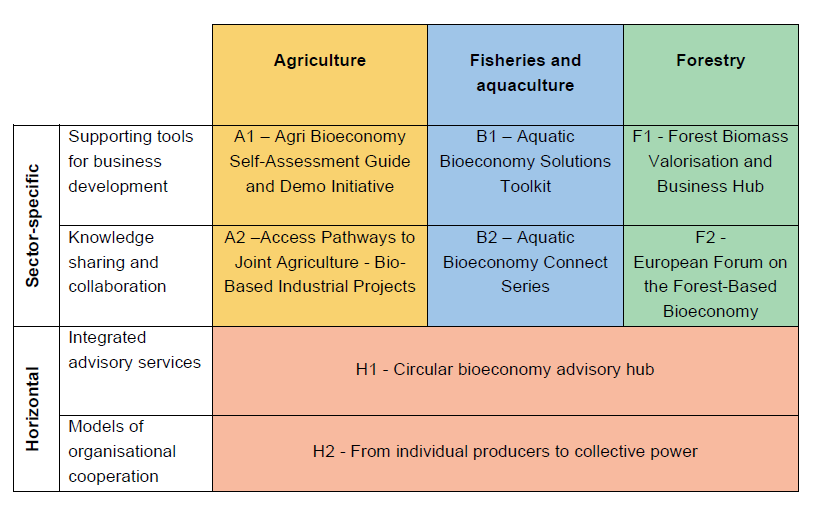
The plan includes six sector-specific actions, with two dedicated to each sector. These focus on developing business opportunities and strengthening cooperation across bio-based value chains.
Two additional horizontal actions bring primary producers from all three primary sectors together to address common challenges. They focus on improving bioeconomy advisory services and exploring cooperative business models.
Sector-specific actions
The action plan proposes practical tools and activities to help primary producers develop new business opportunities and strengthen their role in circular bio-based value chains.
- In agriculture, a self-assessment guide will help farmers identify and develop new business opportunities using their biomass and by-products. Demonstration visits will provide opportunities to learn from successful business models, while regional activities will support the development of joint projects.
- For fisheries and aquaculture, an online toolkit will provide business cases, and decision-support resources to help producers assess opportunities for circular bio-based solutions. Matchmaking activities will connect producers with potential partners across aquatic biomass value chains.
- In forestry, a knowledge hub will help forest owners and managers assess and develop new business opportunities using undervalued and underused forest resources. A European forum will also support knowledge sharing and cooperation across forest-based value chains.
Strengthening cooperation across sectors
The two horizontal actions bring together primary producers from agriculture, forestry and the aquatic primary sector to address challenges that extend beyond individual sectors.
A circular bioeconomy advisory hub will strengthen connections between advisory services and primary producers across sectors. It will provide practical business and technical guidance, including support with financial decisions.
The second action will explore cooperative business models that help smaller producers pool resources and strengthen their position in bio-based value chains. Workshops and practical guidance will support producers in identifying cooperation models suited to their needs.
Putting the action plan into practice
Implementation is planned throughout 2026-2029, with support from RootLinks, the Working Group on Primary Producers and other partners across Europe's bio-based value chains.
The activities will build on existing European networks and encourage closer cooperation with relevant stakeholders, including regional authorities and the bio-based industry. Particular attention will be given to involving producers from different European regions and making the results available for long-term use.
The action plan will also be discussed at the Global Bioeconomy Summit 2026 in Dublin, where a workshop on 20 October will bring together international stakeholders to exchange experiences on strengthening primary producers' role in the bioeconomy.