Publication date:
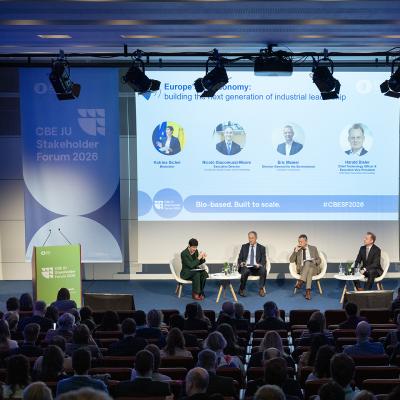
The second edition of the CBE JU Stakeholder Forum held this Tuesday 24 March in Brussels, attracted around 400 participants from 40 countries, bringing together stakeholders from across the bio-based community. Key takeaways included: regulation can drive market growth, targeted funding is needed to scale technologies, and cross-sector collaboration ensures that innovation meets industrial needs.
Speakers highlighted the energy, expertise and entrepreneurial spirit across the community, noting that the drive, ideas and innovations to advance sustainable and circular industries in Europe is firmly in place. Speakers emphasised three critical enablers for success:
- Regulation as an accelerator: smart, well-aligned regulation can create sustainable markets, turning constraints into competitive advantages.
- Funding for scale-up: beyond early-stage grants, robust financial mechanisms are essential to bridge the “second valley of death” and enable industrial deployment.
- Collaboration and ecosystem diversity: cross-sector partnerships, strengthen knowledge exchange, align innovation with industrial needs and promote practical solutions for scaling technologies.
Europe’s biomass availability and strong industrial base offer a chance to reduce fossil dependency and advance the circular economy. Tangible examples from everyday bio-based products to first-of-their-kind biorefineries demonstrate the sector’s potential and make the business case for scaling bio-based solutions clear to investors, policymakers and industry leaders.
The forum reaffirmed CBE JU as a key driver of the EU Bioeconomy Strategy and the upcoming Biotech II Act and Circular Economy Act, by bridging research, policy and industry it creates a unique platform to scale innovations while keeping Europe competitive and sustainable.
Programme highlights: from policy vision to real-world impact
Under the overarching theme “Driving Impact – Bio-based innovation for a competitive, sustainable Europe,” four distinct panel discussions addressed critical bottlenecks in commercial deployment, access to finance, regional ecosystem development and regulatory frameworks.
The opening plenary set the strategic context, with speakers reflecting on how bio-based innovation is contributing to Europe’s competitiveness and resilience. Discussions addressed the evolving geopolitical and policy landscape and highlighted the role of industrial ecosystems and public-private partnerships in scaling sustainable solutions helping to address current challenges.
For the past decade, CBE JU is building the partnerships and investment pathways needed to transform breakthrough ideas into industrial reality, strengthening Europe’s competitiveness while creating value for citizens, regions and businesses. The challenge now is to move faster from innovation to deployment.
Nicoló Giacomuzzi Moore
The first panel focused on the critical transition from laboratory to industrial demonstration. Industry executives, researchers and policymakers shared insights on the technical, regulatory and systemic conditions needed to bring promising technologies to demonstration plants, highlighting concrete examples from CBE JU-funded projects. Building on real industrial experiences, the afternoon panel explored how companies move from demonstration to full commercial deployment. Discussions centred on access to finance, investment predictability and market demand, outlining what is missing for Europe to accelerate the large-scale adoption of bio-based products and strengthen its position in sustainable industrial transformation.
At the closing of the forum, speakers representing the public & private sectors of the JU, the European Commission & the Bio-based Industries Consortium, discussed how CBE JU can continue supporting Europe’s bio-based sector. Policy tools, funding instruments and industrial partnerships can be better aligned to drive innovation, address remaining gaps and strengthen Europe’s competitiveness in the global bioeconomy.
Exhibition: spotlight on impactful innovations
The event featured an exhibition of 50 bio-based solutions developed by CBE JU-funded projects, giving participants a first-hand look at prototypes, advanced materials and commercially viable technologies that are reshaping sectors, from chemicals, construction, agro-industrial systems and sustainable textiles. Among the exhibition highlights were:
Bio-based polymers designed for enhanced recyclability and reduced environmental footprint
Novel biomaterials for construction and packaging applications
Advanced agricultural inputs derived from non food biomass
Next generation textiles developed via sustainable processes
Tasting stations that showcased how we can replace chemicals with bio-based alternatives
Project representatives came from across Europe to demonstrate prototypes, explain innovation pathways and discuss commercialisation challenges.
Conclusions & forward outlook
With CBE JU’s work continuing through the upcoming 2026 call and networking initiatives, the bioeconomy community is ready to transform collaborative insights into impactful results. Key takeaways emphasised the need for:
Accelerated industrial deployment of existing bio based solutions
Enhanced access to diverse financing mechanisms
Alignment of policy frameworks with industrial realities
Strengthened international collaboration and knowledge transfer
As Europe continues its transition toward a more circular, bio based economy, the 2026 Stakeholder Forum has set a clear agenda for scaling innovation, sharing best practices and reinforcing the value of collaboration across regions and value chains.