Publication date:
From 20 to 21 October, CBE JU took part in the Global Bioeconomy Summit (GBS2026) in Dublin, showcasing almost 30 bio-based products and solutions developed by its funded projects. Through a plenary contribution, a workshop on primary producers and an information stand, CBE JU also contributed to the international discussion on scaling up bio-based innovation.
The fifth edition of the Global Bioeconomy Summit took place at the Convention Centre Dublin during Ireland's Presidency of the Council of the European Union. Organised by the Government of Ireland and the International Advisory Council on Global Bioeconomy, it brought together policymakers, researchers, industry representatives, investors and civil society from around the world. The Summit’s theme, “Bioeconomy for Socio-Economic Transformation and Climate Action”, framed discussions on how bio-based solutions can help address food and energy security, biodiversity loss and climate change.
CBE JU Head of Programme, Virginia Puzzolo, joined the opening plenary session to discuss what it takes to bring bio-based innovations to industrial scale. Drawing on CBE JU's experience of supporting projects from early-stage development to demonstration and flagship deployment, her contribution highlighted the importance of de-risking investment, connecting innovators with industry and finance, and creating the right conditions for new products to reach the market.
Bio-based solutions on display
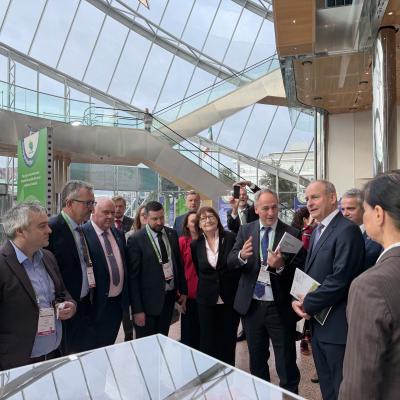
In the event foyer, 29 products developed by CBE JU-funded projects showed how bio-based solutions are finding applications across many sectors. Visitors could see, first hand, an electric scooter made of hemp-composite , a commercially available loudspeaker, lignin-modified asphalt that is currently being used to pave roads in over 10 countries globally, alongside many other products for textile, construction, health and packaging.
The exhibition welcomed a large number of visitors, including Micheál Martin, Taoiseach of Ireland; Jessika Roswall, European Commissioner for Environment, Water Resilience and a Competitive Circular Economy, together with Darragh O’Brien, Minister for Climate, Energy and the Environment, Martin Heydon, Minister for Agriculture, Food and the Marine and Noel Grealish, Minister for State at the Department of Agriculture, Food, Fisheries and the Marine with responsibility for Food Promotion, New Markets, Research and Development.
It also attracted representatives of financial and diplomatic institutions, including Gelsomina Vigliotti, Vice-President of the European Investment Bank; Nicola Faganello, Ambassador of Italy to Ireland; and Phil Hogan, Ireland’s candidate for Director General of the FAO. Their visits underlined the interest of European and Irish decision-makers in bio-based innovation and its industrial scale-up.
Engaging primary producers in bioeconomy
On the first day of the summit, CBE JU co-hosted a workshop on the role of primary producers in bio-based value chains, together with Ireland's National Bioeconomy Research Centre BiOrbic, the Rootlinks project and ReFarm Ireland. CBE JU Programme Officer Ana Ruiz Sierra led the session, which built on the work of the CBE JU working group on primary producers and their new action plan. Participants discussed how farmers, foresters and other primary producers can take a stronger role in the bioeconomy.
The following priorities were identified:
involving primary producers as business partners in bio-based value chain
strengthening collaboration along the value chain
raising awareness of the opportunities offered by underused biomass
ensuring that the needs and perspectives of primary producers are heard
Mobilising investment for the bioeconomy
On 21 October, on the margins of the Summit, the Bioeconomy Investment Deployment Group (BIDG) held its second plenary meeting. Established as a joint initiative of CBE JU and the European Commission, with the support of the European Investment Bank, the group brings together public and private financial stakeholders to acess how investment can be mobilised for Europe’s bioeconomy. In Dublin, participants agreed on a roadmap to close financing gaps and build a stronger pipeline of investment-ready projects.
Connecting with the bio-based community
At the CBE JU stand, visitors met CBE JU project officers and learned more about the joint undertaking and its funding opportunities. Participants explored the CBE JU interactive dashboards and tested their knowledge of feedstocks and their potential applications with the Go for bio-based game. At the tasting station, they sampled food and drink products that illustrate the range of bio-based innovation:
coffee packaged in bio-based and compostable capsules
pesto using botanical extracts as a natural stabiliser
wine in which microalgae-based stabilisers replace sulphites
drinks made with MEY™ powder, a protein-rich microalgae ingredient produced through fermentation using CO₂-derived carbon
The stand proved a lively meeting point for conversations with researchers, entrepreneurs, policymakers and investors from across the bioeconomy community.
Looking ahead
GBS2026 confirmed that the bioeconomy conversation is increasingly about delivery: moving from promising results to industrial deployment. CBE JU was honoured to present the achievements of its funded projects and to contribute to the debate on industrial scale-up, market uptake and the role of primary producers. Panama will host the next edition of the Summit, in 2028, the first time the event will take place in Latin America and the Caribbean.