Publication date:
Europe’s bio-based food and feed innovation is moving beyond the laboratory. Across 47 projects, CBE JU has provided €287.8 million in EU funding for new food and ingredients, protein sources and production processes. Together with the industrial contribution, this represents €409.5 million in investment.
The projects on food and feed ingredients account for around one fifth of the CBE JU’s portfolio, and much of their activity is already focused on scale. Nearly 60% of the 47 projects are demonstration or flagship actions, supporting innovation at pilot or industrial scale and bringing it closer to market.
The focus on demonstration and industrial production is particularly relevant following the European Commission’s new strategic approach to agri-food research and innovation, adopted on 8 September. Its AgRI 2040 and Food 2040 frameworks emphasise deployment and market uptake, with users involved more closely in developing and testing solutions.
Europe does not lack promising food and feed innovation. The challenge is getting more of it through demonstration and towards competitive industrial production. CBE JU helps companies overcome the risks of scale-up and bring partners across the value chain into that process. The resulting facilities and evidence can then support further investment and deployment in Europe.
Nicoló Giacomuzzi-Moore, CBE JU Executive Director
Scaling innovation beyond the lab
The CBE JU portfolio on food and feed spans the entire innovation pipeline from research and process validation to pilot production, demonstration facilities and first-of-a-kind industrial plants.
Projects report 131 new products with potential food and feed applications. Of these, 102 are food and feed ingredients, including 60 food products and 42 feed products. A further 29 are bio-based chemicals with potential applications in these markets.
What matters, however, is not only how many products are being developed but whether the processes behind them can operate reliably at larger scale. For this reason, demonstration in pilot facilities generates evidence on production performance, costs and product quality before companies commit to further investment.
Making more of biological resources
CBE JU-funded projects start with biological resources readily available in Europe: agricultural and food-industry sidestreams, crop residues, grass and aquatic biomass.
The completed UP4HEALTH project, for example, recovered higher-value ingredients from agricultural processing by-products. Its work included an olive pulp powder containing dietary fibre and polyphenols, which was tested in enriched snack bars.
This approach complements efforts to prevent food loss and waste. Some sidestreams and residues are unavoidable, and recovering proteins, fibres or other valuable components allows the original biomass to be used to its full potential.
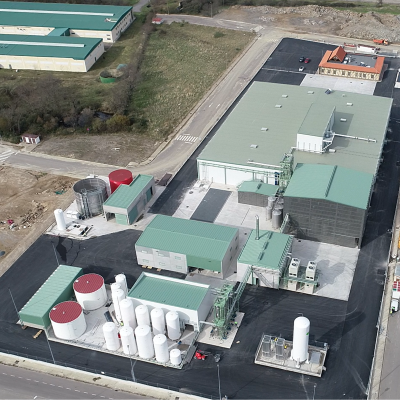
SUSTAINEXT is taking this approach towards industrial scale in Extremadura, Spain. The flagship project is adapting an existing production plant as a multi-product biorefinery designed to process 20,000 tonnes of locally sourced biomass each year. Rosemary, camomile and lemon verbena will be used alongside sidestreams from olives, cardoons and pomegranates to produce plant-based extracts and functional ingredients for markets including food and feed.
The project aims to integrate 12 value chains and produce 46 extracts and ingredients. Its industrial model is also closely connected to the surrounding rural economy. New medicinal and aromatic crops are being cultivated on disused tobacco fields, while partnerships with the local farmers will supply agricultural sidestreams to the biorefinery.
Scaling up SUSTAINEXT means bringing a highly innovative, dynamic biorefinery concept to industrial reality, allowing Natac to produce more, more efficiently, for highly competitive food and feed markets. It embodies our ‘Science to Market’ approach while creating new value chains around underused agri-food biomass and medicinal and aromatic plants sourced from local growers.
José María Pinilla Rosas, NATAC Head of Project Management
Other projects show how multiple products can be recovered from the same resource. ALLIANCE, for example, is developing microalgae biorefineries with food and beverage applications alongside aquafeed and other bio-based products. Rather than depending on a single output, the model combines several product streams within the same biorefinery. This can strengthen the business case for more complete use of the biomass while opening routes into different markets.
Diversifying Europe’s protein sources
Fermentation is a key technology of CBE JU’s food and feed portfolio. Projects work with fungal and microbial fermentation, gas fermentation and continuous processes designed for larger-scale production.
The ZEST project is developing fungal protein ingredients from agricultural and food-industry sidestreams while improving bioreactor performance and downstream processing. MycoStruct is using liquid fermentation to produce structured mycelium ingredients for whole-cut meat alternatives and aims to scale production to a 5,000-litre demonstration facility, with a target output of 25 tonnes per year.
With the help of CBE JU, the project is developing a completely new generation of meat alternatives, using a new proprietary fermentation technology to replicate the structure of animal muscle tissue.
Gareth Payne, Chief Product Officer at Adamo Foods, MycoStruct project
Other projects demonstrate how different fermentation routes can widen the range of feedstocks and production systems available. SynoProtein uses biogenic gases produced from sawmill residues to grow microorganisms for protein-rich fish feed, while PROSCALE is developing continuous fermentation using food-industry sidestreams for human food ingredients.
Protein innovation also extends beyond fermentation. The completed GreenProtein project demonstrated the recovery and purification of food-grade RuBisCO protein from vegetable-processing residues, showing how plant-based sidestreams can provide new sources of protein for food applications.
Aquatic biomass offers another route. CleanAlgae2Value is developing food-grade protein isolates from microalgae alongside other ingredients and testing them in food applications. Its work addresses both production scale-up and the quality requirements needed for wider use.
CleanAlgae2Value represents an important step towards a new generation of European alternative proteins. By combining microalgae biotechnology, circular carbon utilisation and food-grade ingredient development, the project aims to demonstrate how Europe can produce nutritious, functional and sustainable protein ingredients while reducing dependency on conventional agricultural inputs and supporting industrial decarbonisation.
Vasilis Stenos, CEO of Solmeyea, CleanAlgae2Value project
Together with the fermentation, these approaches show the diversity of CBE JU-supported protein innovation across biological resources and production technologies, including fungi, microorganisms, plants and algae.
Bringing production to industrial scale
Some projects have already moved beyond demonstration and shown what fermentation-based protein production can look like in a real industrial setting.
The CBE JU-funded PLENITUDE project established a first-of-a-kind mycoprotein facility in Sas van Gent, the Netherlands. Rather than developing a standalone production process, the project integrated aerobic fermentation with an existing conventional biorefinery, creating a circular production system for food-grade mycoprotein.
The facility is now operational, with a potential production capacity of 10,000 tonnes per year. The project reported its first commercial supply in 2025. The project also worked across the value chain to develop applications for the resulting mycoprotein, including food and pet food. Its experience demonstrates that fermentation-based alternative proteins can progress from laboratory development to large-scale production using existing industrial infrastructure.
PLENITUDE, therefore, provides an industrial reference for newer projects such as SUSTAINEXT and MycoStruct, which are advancing production at different stages of scale-up. Together, they illustrate the pathway CBE JU supports: developing and validating new processes, demonstrating them at larger scale and building the evidence needed for wider market deployment.
Integrating primary producers in new value chains
Bio-based food and feed innovation can also create new opportunities for primary producers through better use of agricultural residues and sidestreams. Where these resources can be recovered and processed, they may provide additional sources of revenue and support new business models in rural areas. The CBE JU-funded Rural BioReFarmeries project is testing this approach through a small-scale production model designed around grassland farming. Fresh grass is separated into a fibre-rich fraction that can remain in livestock feed and a liquid fraction from which protein and other components can be recovered. The project has already produced grass-derived protein samples containing more than 70% crude protein.
In September, Ireland’s first on-farm demonstration-scale facility integrating grass biorefining and anaerobic digestion opened in County Cork. It will allow the project to test the model under real farming conditions and examine what farmers and cooperatives would need to adopt it elsewhere.
Primary producers have the opportunity not only to supply biomass, but also to take a stronger role in the value chains built around these resources. CBE JU’s Working Group on Primary Producers is looks for ways to support this participation, including access to finance and knowledge, cooperation with industry and how producers can benefit from their involvement.
There are significant opportunities for all primary producers to benefit from new bio-based value chains and to move beyond the position of passive price-takers. This can only happen through greater collaboration both between primary producers and across sectors. Producer co-operatives can aggregate for scale, more efficient logistics and processing and market access, but the real power comes in going a further step, collaborating with research organisations and industry and even to co-ownership of facilities. That brings next generation research to commercial reality, brings full value chain integration and a fairer distribution of value.
John Brosnan, Chair of CBE JU Working Group on Primary Producers
Bridging the gap from demonstration to market
Technical success is only one condition for market uptake.
At the June CBE JU food and feed cluster workshop, projects highlighted regulatory pathways for novel foods and feed additives, access to investment and suitable industrial infrastructure, consumer acceptance and the transition from demonstration to competitive production as important factors affecting further deployment.
Access to infrastructure can be particularly important for smaller companies. UP4HEALTH, for example, reported that its operating pilot plant had subsequently hosted ALEHOOP trials on protein recovery from lupin by-products, showing how facilities developed through one project can continue supporting scale-up elsewhere.
These challenges also reflect conclusions of CBE JU’s wider 2026 stakeholder study, which called for stronger links between innovation, investment and market uptake and better access to pilot and demonstration infrastructure.
The new AgRI 2040 and Food 2040 approach puts many of the same questions at the centre of future EU research and innovation: how to test solutions in real conditions, involve users and help promising innovations move towards deployment.
CBE JU’s food and feed portfolio shows that this pathway is already being built. The next challenge is ensuring that promising ingredients and production processes can make the final step towards competitive industrial use, with primary producers and other actors across the value chain able to participate in the opportunities created.